
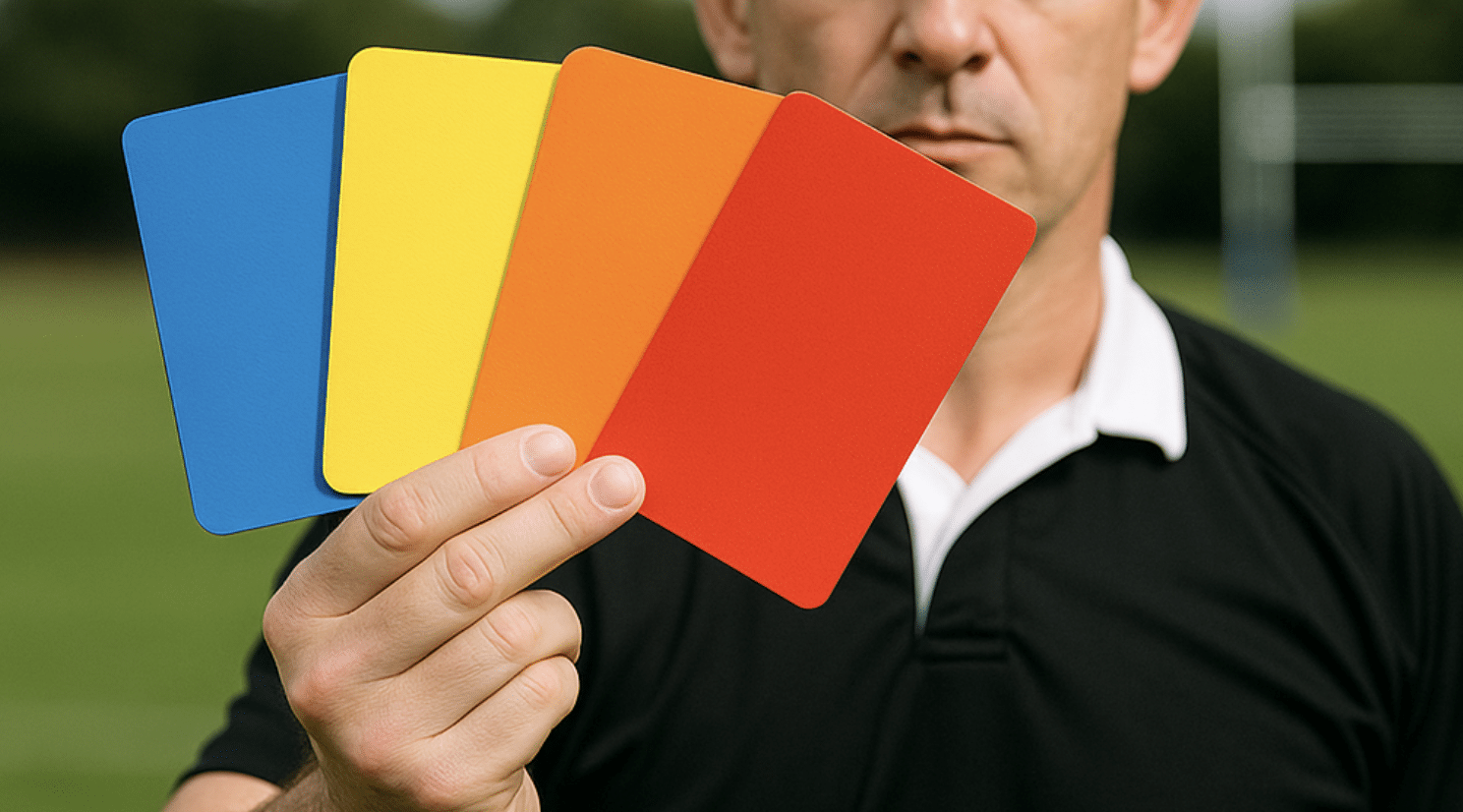
🟥 Red Card
“You’re off — and you’re not coming back”
A red card is the most serious punishment a referee can issue. It means a player is sent off for the remainder of the match and cannot be replaced (though some competitions now allow a replacement after 20 minutes).
[ad_connatix]
Offences that usually result in a red card include:
- Dangerous or reckless tackles (especially involving the head or neck)
- Striking, stamping, or kicking an opponent
- Serious foul play
- Verbal or physical abuse of officials
- Repeated misconduct after prior warnings
In recent years, rugby authorities have trialled a 20-minute red card, allowing a substitute after that period to maintain the balance of the contest while still punishing the offence.
The red card remains a powerful deterrent — the ultimate signal that safety and respect come first.
🟦 Blue Card
“You’re off for your own safety”
The blue card isn’t a punishment — it’s about player welfare.
Introduced in some domestic competitions (particularly in New Zealand and Australia), the blue card is shown when the referee or medical staff suspect a player has suffered a concussion or head injury.
When shown a blue card, the player must leave the field immediately and cannot return to play in that match. It also triggers a mandatory medical protocol, meaning the player must be assessed and complete a graduated return-to-play process before being cleared for future matches.
The blue card is one of rugby’s most important modern developments — a clear sign that protecting players’ brains is now a top priority.