
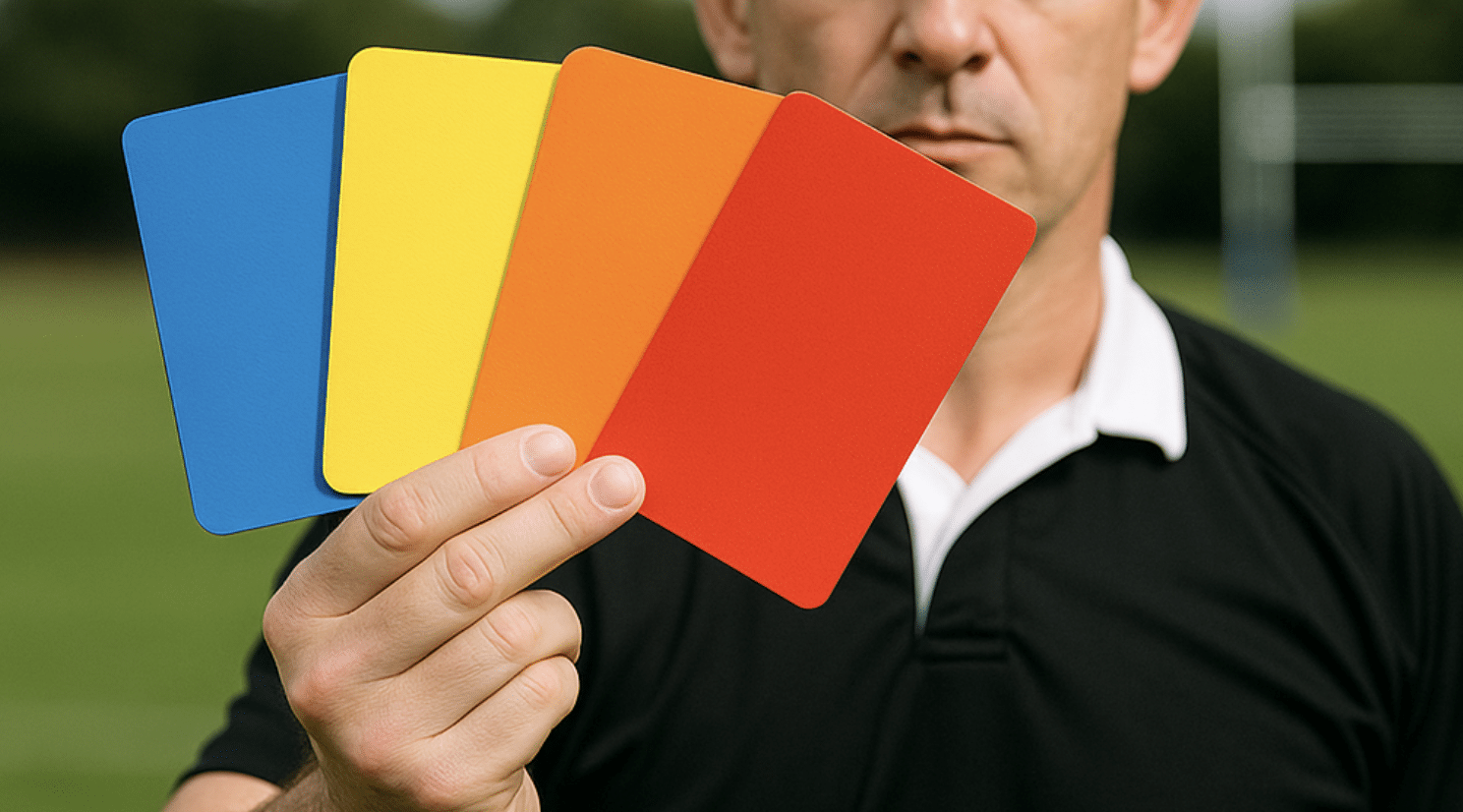
Rugby has always prided itself on discipline, respect, and player safety. To help referees manage the game and protect players, a system of coloured cards is used to indicate different levels of offences or welfare concerns.
Traditionally, fans were familiar only with yellow and red cards — but new developments in the sport have introduced blue and orange cards to address emerging issues in player welfare and match discipline.
[ad_connatix]
Here’s everything you need to know about all four cards used (or trialled) in modern rugby.
Join RUCK’s Instagram broadcast channel and get the latest rugby news straight to your phone.
🟨 Yellow Card
“Ten minutes in the bin”
The yellow card is the most common sanction for offences more serious than a standard penalty but not severe enough to warrant a red card. When a player receives a yellow, they are sent to the sin bin for 10 minutes, and their team must play with one fewer player during that time.
Typical reasons for a yellow card:
- Repeated team infringements
- Professional fouls (like killing the ball near the try line)
- Dangerous tackles without malice
- Deliberate knock-ons
- Cynical play preventing a scoring opportunity
If a player receives two yellow cards in the same match, it automatically results in a red card.
The yellow card strikes a balance — it’s a warning and a punishment that can completely change the flow of a game.